 |
| from the left: Fred Sigernes, Dave Olson, Margit Dyrland, Dag Lorentzen, Geoff McHarg, Allison Jaynes, Marc Lessard, Erik Lundberg click us for a better view! |
Friday, December 3, 2010
The Svalbard Team

Tuesday, November 23, 2010
Payload Assembly
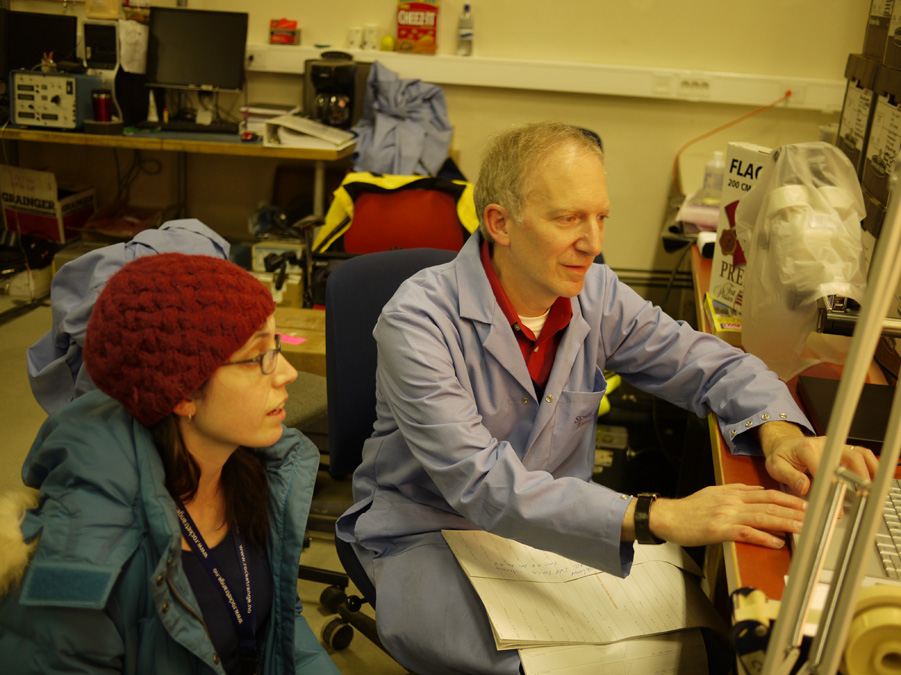
Rocket missions require a lot of patience. There is always a waiting game going on, which was the case when I first arrived here. The whole first day was off for experimenters, so I went with some colleagues to the great metropolis of Sortland, Norway. The views along the coastal drive were outstanding. After finally receiving all the shipped boxes and unpacking the instruments, we installed them into the payload. Here is Steve Powell and myself, hard at work as always.

Below is the aft end of the payload, showing the UNH Imager poking out the bottom, as well as some other gadget I'm not familiar with. The imager baffle (like a long shade you can see on the end of some camera lenses) has the end covered in this picture by a piece of black plastic and a rubber band. This cover comes off before flight, and is just there temporarily to shield the CCD from light and dust.

The next picture shows the forward end of the payload or the side that will be pointing "up" for the duration of the flight. The two small black tubes (one on the far left and one towards the middle front) are UNH instruments. One is the Star Sensor which is a spare IBEX satellite instrument that we are flying to see if we can align with the distant stars as an attitude control system. This is the first time a star sensor has been flown on a sounding rocket. The other is the PMT (photomultiplier tube), probably the integral instrument for my PhD thesis. I'll explain more about that later. The bigger black tubes are the Aerospace PMTs. I like the very clear "Remove Before Flight" tags - so professional!

The final picture is of Dave Collins from Dartmouth, checking out the HEEPs and BEEPs instruments on the main payload. You can see the nose cone to the left, which has not been put on yet. David Olson, from University of Maryland, can be seen in the background doing the most common activity of our days here: trying to stay busy until it's your turn to do some instrumentation. Things are very organized and go so smoothly, mostly thanks to the wonderful Wallops people who know how to run the show.

The workdays have been long... we start at 8am and go until 5-7pm. But it's not all too bad - we got two days off last weekend and did an epic 8 hour road trip to Tromso where we spent two nights at the SAS Radisson and had a blast. This week we've done some sequence testing so far and others have been working on telemetry and getting the motors prepped and on the rails. I only have four more days in Andenes. Then it's off to snowy, dark Longyearbyen on the arctic island of Svalbard!
Below is the aft end of the payload, showing the UNH Imager poking out the bottom, as well as some other gadget I'm not familiar with. The imager baffle (like a long shade you can see on the end of some camera lenses) has the end covered in this picture by a piece of black plastic and a rubber band. This cover comes off before flight, and is just there temporarily to shield the CCD from light and dust.

The next picture shows the forward end of the payload or the side that will be pointing "up" for the duration of the flight. The two small black tubes (one on the far left and one towards the middle front) are UNH instruments. One is the Star Sensor which is a spare IBEX satellite instrument that we are flying to see if we can align with the distant stars as an attitude control system. This is the first time a star sensor has been flown on a sounding rocket. The other is the PMT (photomultiplier tube), probably the integral instrument for my PhD thesis. I'll explain more about that later. The bigger black tubes are the Aerospace PMTs. I like the very clear "Remove Before Flight" tags - so professional!

The final picture is of Dave Collins from Dartmouth, checking out the HEEPs and BEEPs instruments on the main payload. You can see the nose cone to the left, which has not been put on yet. David Olson, from University of Maryland, can be seen in the background doing the most common activity of our days here: trying to stay busy until it's your turn to do some instrumentation. Things are very organized and go so smoothly, mostly thanks to the wonderful Wallops people who know how to run the show.

The workdays have been long... we start at 8am and go until 5-7pm. But it's not all too bad - we got two days off last weekend and did an epic 8 hour road trip to Tromso where we spent two nights at the SAS Radisson and had a blast. This week we've done some sequence testing so far and others have been working on telemetry and getting the motors prepped and on the rails. I only have four more days in Andenes. Then it's off to snowy, dark Longyearbyen on the arctic island of Svalbard!
Thursday, November 18, 2010
RENU Field Campaign

We have made it! The RENU team has arrived at Andoya Rocket Range in Andenes, Norway. The instruments and shipments have all (more or less) arrived and buildup has begun. These are the final few weeks after over a year of hard work. Buildup and sequence checks will take most of the next week and a half. Next Friday, several team members (including myself) fly to the remote island of Svalbard to take our positions at the EISCAT radar field station in Longyearbyen just in time for the start of the launch window. We will all be staying at the University there, UNIS. Photos of the range and the payload buildup to come soon!
Saturday, November 13, 2010
On my way
The time has come! I'm on the bus that takes me to the airport that takes me to Germany, then Oslo, then Tromso, and finally Andenes, Norway. The trip will take a total of about 24 hours to complete, including a maddening 5 hour layover in Tromso. That airport better have waterslides and ponies. From here on out, the time will be about 6 hours later for me than it is for you. And when I switch to night shifts once the window opens, it will really get interesting. Next post will be coming to you from the frozen lands of northern Norway!
Monday, October 11, 2010
Deployment & Vibration Testing
Although I got a vacation on Sunday, Friday and Saturday were very very long days (14.5 and 12.5 hours respectively). However, we got a lot done (by NASA standards at least) - we went through all of the vibration testing and some of the deployment testing. For the vibe tests, they mount the rocket on a vibration table:
Then they vibrate it at various frequencies in different directions. They do the x, y and z (or thrust) axis and the do random patterns too, to try and determine inherent resonant frequencies of the payload. I watched one test... it got pretty loud when the vibration went up to 2,000 Hz (that's 2,000 vibration cycles a second!) and luckily nothing went too wrong with our instruments. Although we did find out later that perhaps one of our integral screws worked its way out during the tests. Uh oh. It's easy to fix though. Most of the time, I can't really watch the tests. I'm stuck in another room watching various screen and strip charts for our instrument read-outs. Here's an example of what I stare at part of the day.
Between vibration tests we did a few deploy tests. This is to check that every piece that ejects off the payload will do so nicely without effecting our instruments too much. Saturday we did a nose cone deploy test, where they hang the payload upside down in a padded room (first picture) and then "fire" the nose cone eject V-bands. They pop off at an amazing speed and the nose cone falls into the pile of cardboard boxes below -- really high tech stuff. I took a video from the upper mezzanine, looking through a plexiglass shield down into the padded room. Check it out, it's kind of fun.
Here's the nose cone after they've ejected it from the payload. The remainder of the tests will be done without the cap on.
 |
| Wayne in the padded room |
 |
| Looks like the future! |
Here's the nose cone after they've ejected it from the payload. The remainder of the tests will be done without the cap on.
 |
| Poor little nose cone |
Overall the tests have gone well and the news is good, all except for that errant screw. Today was a semi-long day... we're still here at 9pm and not going home any time soon. But we weren't allowed to come in until noon since it was a safety hazard while they were doing pyro stuff. Tomorrow is mag cal testing and the final post-vibe sequence test. I may get to go home eventually! Tonight I will leave you with a most excellent packaging label. I want a whole roll of these stickers.
 |
| Critical! We're serious! |
Friday, October 8, 2010
Integrating!
Integration is moving along. Slowly, but moving. According to some, this is them going top speed, so I can't complain. But there is definitely a lot of "hurry up and wait" syndrome going around. Been getting here by 7:30-8 am and leaving around 8 pm. Not too bad since a couple people have done 6am-10pm days last week!


Yesterday we made it through pre-vibe sequence tests. That means we did a few mock launch sequences (before vibration tests) where we mimic the countdown, turn all systems on in sequence, turn on high-voltages in sequence and even blow a little ACS gas (attitude control system). One test, the all-fire test, was just like the launch will go: everything turning on at the right times. The other two tests were the no-fire tests or the power backups tests, where they didn't turn all systems on. This was to check for redundancies in the power systems.

The actual 800 some seconds when we are doing the sequence is pretty exciting. I have to run back and forth between a couple of screens and strip charts to check on the health of my instruments throughout the sequence. And there are a few events that I have to keep an eye on, such as when we turn on the despin motor for our imager or when we turn on the high voltage to a few of our other instruments. There are several other experiment teams running back and forth watching at the same time, so it gets a bit hectic. In the picture above, Jim Diehl (our Telemetry Engineer) is calling the events and watching the overall progress of the count. He's the one in the foreground with the phone. Everything went pretty swimmingly so we are moving on today to the vibration testing. And then comes the post-vibe sequencing. Fun stuff!

In the end, if you haven't understood anything at all that I've said, just go watch Apollo 13 again. It's the same thing. I swear. :)

Payload without the nose cone (you can see it sitting in the background)

Frozen condensation outside the liquid nitrogen hose
Yesterday we made it through pre-vibe sequence tests. That means we did a few mock launch sequences (before vibration tests) where we mimic the countdown, turn all systems on in sequence, turn on high-voltages in sequence and even blow a little ACS gas (attitude control system). One test, the all-fire test, was just like the launch will go: everything turning on at the right times. The other two tests were the no-fire tests or the power backups tests, where they didn't turn all systems on. This was to check for redundancies in the power systems.

Mock launch sequence
The actual 800 some seconds when we are doing the sequence is pretty exciting. I have to run back and forth between a couple of screens and strip charts to check on the health of my instruments throughout the sequence. And there are a few events that I have to keep an eye on, such as when we turn on the despin motor for our imager or when we turn on the high voltage to a few of our other instruments. There are several other experiment teams running back and forth watching at the same time, so it gets a bit hectic. In the picture above, Jim Diehl (our Telemetry Engineer) is calling the events and watching the overall progress of the count. He's the one in the foreground with the phone. Everything went pretty swimmingly so we are moving on today to the vibration testing. And then comes the post-vibe sequencing. Fun stuff!

This is Phil's "I'm a real scientist!" pose
In the end, if you haven't understood anything at all that I've said, just go watch Apollo 13 again. It's the same thing. I swear. :)
Wednesday, October 6, 2010
Time to Restart the Blog!!
It's that time again! My rocket adventures continue. This time I will be traveling to snowy Norway with the hopes of successfully launching a sounding rocket into the polar cusp region of the Earth's magnetosphere.

Right now, I'm at Wallops Flight Facility busily trying to integrate the rocket payload and getting it ready to ship to Norway. To the left, you can see the the rocket on the spin table, where just last night they spun it up to 3 Hz (which is 180 rpm - pretty fast!) to test whether or not it was balanced properly (it was not). I'll be hanging out here off and on for the next two weeks or (gasp!) maybe more while the process of integration shuffles slowly toward an acceptable conclusion.

The next step is to travel to Norway. I'll be leaving from Boston on Saturday, November 13th and arriving many flights later in Andenes, Norway. After 2 weeks in Andenes, at the Andoya Rocket Range, helping to get things up and running there, I will scoot off to the far, far North: Longyearbyen, a cozy little arctic town on the island of Svalbard, Norway. There I will remain until the rocket launches! To the right, you can see a little map I made showing my two locations. Longyearbyen is at 78°N (just 12° south of the geographic north pole!) and so it will be dark for 24 hours a day during my stay. This is a vast difference from my last northern expedition to the North Slope of Alaska. The sleepy village of Kaktovik where I stayed 2 years ago is only at 70°N latitude, and during that particular time window (late February) we had several hours of dawn/dusk sunlight per day. This trip I will see none while in Longyearbyen. My boss describes it as pretty surreal to see schoolchildren running home from school with backpacks on under the nighttime sky, with only street lights to illuminate the way.
Well, there will be more updates to come. Stay tuned. I'm ready for another arctic adventure!

Right now, I'm at Wallops Flight Facility busily trying to integrate the rocket payload and getting it ready to ship to Norway. To the left, you can see the the rocket on the spin table, where just last night they spun it up to 3 Hz (which is 180 rpm - pretty fast!) to test whether or not it was balanced properly (it was not). I'll be hanging out here off and on for the next two weeks or (gasp!) maybe more while the process of integration shuffles slowly toward an acceptable conclusion.

The next step is to travel to Norway. I'll be leaving from Boston on Saturday, November 13th and arriving many flights later in Andenes, Norway. After 2 weeks in Andenes, at the Andoya Rocket Range, helping to get things up and running there, I will scoot off to the far, far North: Longyearbyen, a cozy little arctic town on the island of Svalbard, Norway. There I will remain until the rocket launches! To the right, you can see a little map I made showing my two locations. Longyearbyen is at 78°N (just 12° south of the geographic north pole!) and so it will be dark for 24 hours a day during my stay. This is a vast difference from my last northern expedition to the North Slope of Alaska. The sleepy village of Kaktovik where I stayed 2 years ago is only at 70°N latitude, and during that particular time window (late February) we had several hours of dawn/dusk sunlight per day. This trip I will see none while in Longyearbyen. My boss describes it as pretty surreal to see schoolchildren running home from school with backpacks on under the nighttime sky, with only street lights to illuminate the way.
Well, there will be more updates to come. Stay tuned. I'm ready for another arctic adventure!
Subscribe to:
Posts (Atom)
-
 For some strange reason, we have had a lot of media attention over this rocket launch. Maybe not enough tragic death in the world for them ...
 -
 It's high time to re-start the blog! I'm off on another research trip, but this time it's the Frozen South I'm going to. Cur...
 -
 Or at least the top of the US... The airplane ride here on Monday was on a tiny little propeller plane, that could seat maybe 20 people. You...