Monday, January 30, 2012
Back for More
I'm heading back to Alaska in about a week and a half to participate in the launch of another sounding rocket: MICA (Magnetosphere-Ionosphere Coupling in the Alfven Resonator). This time I will be staying at the rocket range the entire time, instead of fleeing to some far-flung place during the actual launch. It seems this will not help me escape the nightmarish cold though, since Alaska is having its coldest January in over a decade. Fun for me.
So check back often, starting next week, and I will once again regale you with tales from the frozen north. Hopefully this will involve some games of Settlers, moose sightings, and snow tubing at the rocket range.

Wednesday, December 15, 2010
3-2-1-FIRE!
We launched! The RENU sounding rocket was launched in the morning of December 12th from Andøya Rocket Range. Dr. Marc Lessard, my boss and the PI, called the launch into a spectacular science event. After having some bad luck with winds (solar and atmospheric), we finally got a day where things were looking good. We were ready, stalled on the first smaller event, and fired into the awesome second one that came by - amazing launch call, Marc! We fired into a great situation: much ionospheric heating, lots of soft precipitation (red aurora) and ion upflow was seen in the radar beam. Everything we had hoped for!
During the launch, a few issues occurred with the payload. As it stands, there were definitely some anomalies but it is too soon to tell how all the instruments & hardware fared. During the coming weeks and months, we will start to sift through the data and piece together what happened when we had strange signals aboard the payload. This is a long, complicated process since massive amounts of data are transmitted during the short, 10 minute flight via radio signals to ground stations as the payload passes overhead. We had signal locks from all satellite ground stations, but there are always inevitable dropouts which have to be compensated for. In all, we may not get all the data we would ideally want, but I'm very excited to take a look at the data we do have. The payload team from Wallops included some extremely hard-working and dedicated people - I have no doubt that they will start getting answers very soon and do their best to put together the puzzle pieces.
Personally, I had a fantastic learning experience, unrivaled by anything in my graduate career thus far. I was fortunate enough to meet some incredible scientists from Norway and the US, give my very first science report over the intercom (like a real PI!!), discover a brand new (to me!) part of the world, and learn an incredible amount from Marc, my advisor. This rocket stuff can be tricky. It can be depressing at times, exhilarating at others. Frustrating, humbling, exciting, lonely and inspiring. But I think I'm catching on... :-)
I can't say it enough, I have worked with the most amazing people on this project. New friends and colleagues, old acquaintances - it has all been a blast. A special thanks for the birthday dinner in Andenes and to those who put up with me when I wasn't in the greatest of moods.
This is not the end! I have several more posts of rocket motors and assembly that I never got around to, so they will be posted posthumously (R.I.P. RENU). Stay tuned...
Monday, December 6, 2010
Driving to KHO!
Enjoy the video below of our adventurous drive to KHO.
Just a normal day in Longyearbyen.
Link to go straight to YouTube is here.
Sunday, December 5, 2010
Rocket Payload
 |
| Here is the RENU rocket! Very big and very full. The bottom 4 items are the 4 motor stages (more about those later) and the top piece is the actual payload. Click for a close-up view. |
Friday, December 3, 2010
Life at KHO
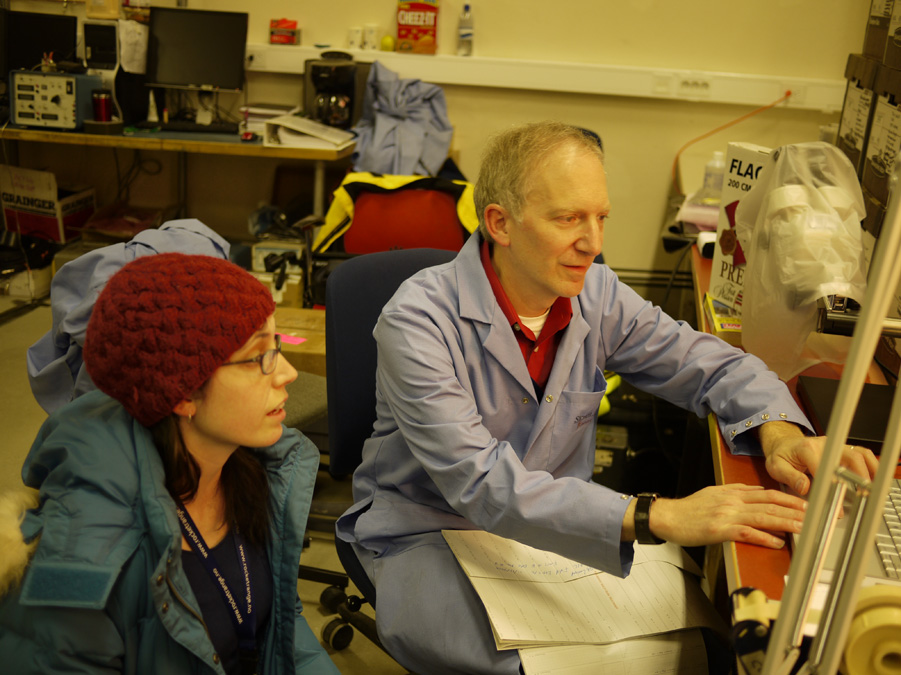
I am currently spending my "days" hanging out at the KHO auroral observatory, watching the atmospheric and solar wind conditions and waiting. The PI (principal investigator) is my boss, Marc Lessard. He looks very PI-ish in this picture!
We have been reporting to our posts at Svalbard University around 1 in the morning. The Skype chats start then and the Andøya rocket range has already been busy getting us ready for the day. At 3 am we start the drive for the top of the mountain, which I believe is called Old Coal Mine #7, and park about halfway up where we then abandon the van and hop in the beltwagon to do the final ascent.
We normally stay at the observatory for about 6 hours, watching the solar wind satellite data and the allsky cameras, as well as the EISCAT radar data. Although most days we have had some technical issues with the rocket, the team down at Andøya has been diligent and determined to fix every little thing that comes up. If the science and weather will just cooperate, we can get this rocket off the ground soon! In the meantime, it's a waiting game.
 |
| All photos today were taken by Margit Dyrland |
 |
| Geoff McHarg and Marc Lessard enjoying the ride |
 |
Wish us luck for an imminent launch!
The Svalbard Team
 |
| from the left: Fred Sigernes, Dave Olson, Margit Dyrland, Dag Lorentzen, Geoff McHarg, Allison Jaynes, Marc Lessard, Erik Lundberg click us for a better view! |
Tuesday, November 23, 2010
Payload Assembly
Rocket missions require a lot of patience. There is always a waiting game going on, which was the case when I first arrived here. The whole first day was off for experimenters, so I went with some colleagues to the great metropolis of Sortland, Norway. The views along the coastal drive were outstanding. After finally receiving all the shipped boxes and unpacking the instruments, we installed them into the payload. Here is Steve Powell and myself, hard at work as always.

Below is the aft end of the payload, showing the UNH Imager poking out the bottom, as well as some other gadget I'm not familiar with. The imager baffle (like a long shade you can see on the end of some camera lenses) has the end covered in this picture by a piece of black plastic and a rubber band. This cover comes off before flight, and is just there temporarily to shield the CCD from light and dust.

The next picture shows the forward end of the payload or the side that will be pointing "up" for the duration of the flight. The two small black tubes (one on the far left and one towards the middle front) are UNH instruments. One is the Star Sensor which is a spare IBEX satellite instrument that we are flying to see if we can align with the distant stars as an attitude control system. This is the first time a star sensor has been flown on a sounding rocket. The other is the PMT (photomultiplier tube), probably the integral instrument for my PhD thesis. I'll explain more about that later. The bigger black tubes are the Aerospace PMTs. I like the very clear "Remove Before Flight" tags - so professional!

The final picture is of Dave Collins from Dartmouth, checking out the HEEPs and BEEPs instruments on the main payload. You can see the nose cone to the left, which has not been put on yet. David Olson, from University of Maryland, can be seen in the background doing the most common activity of our days here: trying to stay busy until it's your turn to do some instrumentation. Things are very organized and go so smoothly, mostly thanks to the wonderful Wallops people who know how to run the show.

The workdays have been long... we start at 8am and go until 5-7pm. But it's not all too bad - we got two days off last weekend and did an epic 8 hour road trip to Tromso where we spent two nights at the SAS Radisson and had a blast. This week we've done some sequence testing so far and others have been working on telemetry and getting the motors prepped and on the rails. I only have four more days in Andenes. Then it's off to snowy, dark Longyearbyen on the arctic island of Svalbard!
Below is the aft end of the payload, showing the UNH Imager poking out the bottom, as well as some other gadget I'm not familiar with. The imager baffle (like a long shade you can see on the end of some camera lenses) has the end covered in this picture by a piece of black plastic and a rubber band. This cover comes off before flight, and is just there temporarily to shield the CCD from light and dust.

The next picture shows the forward end of the payload or the side that will be pointing "up" for the duration of the flight. The two small black tubes (one on the far left and one towards the middle front) are UNH instruments. One is the Star Sensor which is a spare IBEX satellite instrument that we are flying to see if we can align with the distant stars as an attitude control system. This is the first time a star sensor has been flown on a sounding rocket. The other is the PMT (photomultiplier tube), probably the integral instrument for my PhD thesis. I'll explain more about that later. The bigger black tubes are the Aerospace PMTs. I like the very clear "Remove Before Flight" tags - so professional!

The final picture is of Dave Collins from Dartmouth, checking out the HEEPs and BEEPs instruments on the main payload. You can see the nose cone to the left, which has not been put on yet. David Olson, from University of Maryland, can be seen in the background doing the most common activity of our days here: trying to stay busy until it's your turn to do some instrumentation. Things are very organized and go so smoothly, mostly thanks to the wonderful Wallops people who know how to run the show.

The workdays have been long... we start at 8am and go until 5-7pm. But it's not all too bad - we got two days off last weekend and did an epic 8 hour road trip to Tromso where we spent two nights at the SAS Radisson and had a blast. This week we've done some sequence testing so far and others have been working on telemetry and getting the motors prepped and on the rails. I only have four more days in Andenes. Then it's off to snowy, dark Longyearbyen on the arctic island of Svalbard!
Subscribe to:
Posts (Atom)
-
 For some strange reason, we have had a lot of media attention over this rocket launch. Maybe not enough tragic death in the world for them ...
-
 It's high time to re-start the blog! I'm off on another research trip, but this time it's the Frozen South I'm going to. Cur...
-
 Well I've just had a whirlwind of a few days, with little sleep and lots to do. But I'm in the arctic circle now for the duration, s...