Monday, January 31, 2022

Into the Dark

 T minus 3 weeks until I leave for the frozen north. Today in Fairbanks, the high is -15°F and the low is -25. Things change rapidly, but that's how I expect it will be most of the time while I'm there. Hopefully everything goes off without a hitch. (If there's a hitch, it's a big hitch, i.e. Omicron.) To boost those chances, the team has an official song and dance to "summon the aurora" and ensure mission success. It's no banana, but it could help. 


A little rumination about the dark. 

I don't think I talked about this back during my Norway travels, but if you don't see the Sun for a couple weeks, it changes you. In 2010, I traveled to Svalbard (an archipelago far north of mainland Norway) for the RENU rocket launch and didn't see the Sun for two and a half weeks. Up there, in the winter, there is no dawn, no peeking over the horizon, just darkness. The sky gets a tiny bit lighter during the middle of the "day" - say the difference between nightfall and full-on night (slight distinction). It was weird and psychologically rough. When I flew off-island on the way home and landed in Tromsø (the Paris of the north!) and saw the Sun rise for the first time in 18 days, I had a near-religious experience. It made me want to compose an epic poem to a Sun God. Or fall on my knees and wail. Instead I think I quietly cried while staring at the Sun long enough that the words "retinal damage" surfaced in my mind. At a time like that, you really get the obsession of ancient cultures with the Sun, the deification, all of it. The Sun is life. 

On the other side of that - sunlight 24 hours a day, which I experienced in the Antarctic summer - it's not such a big deal. You pull the blackout curtains at night, lower the lights, and hang out like you would in the evenings at home. If you venture outside in the middle of the night into the blinding light, it's a bit of a shock, but doesn't mess with your mental state in the same way as no sun. There's not the visceral attachment to the night, as with the daylight. 

Which seemed odd to me, since I've always preferred the night to the day. Given a choice, I'll take the darkness of night over the daylight almost anytime. In high school and through college, all I wanted was to stay up all night and sleep all day. Funny that it's still the sunlight that is most necessary. Something baked into our reptile brains, for sure. 

So. Into the dark once more. This time of year, Fairbanks gets quite a bit of sunlight, I just won't be awake for most of it. Our launch window is midnight to 4am local time, so I'll be sleeping 7am to 3pm-ish. I will be able to catch some late afternoon daylight though, so not the same thing. And I like to think my mental state is healthier than when I was in grad school. We'll see!


Friday, January 14, 2022

Pre-Covid Ground Support Trip

 In December 2019/January 2020, a contingent of the LAMP ground support team and our PI, Sarah Jones, traveled to Fairbanks, AK to deploy and test some ground-based equipment. (Yes, Covid was already coursing through the population, but we had no idea at the time. Later that month, I did a back-to-back trip to Norway as a lecturer for a sounding rocket school and to Bern for an ISSI meeting. Blissfully unaware of the dark days to come.) 

We had several goals for the trip: reconnaissance of the domes at the Poker Flat science building (size, structures for cameras, etc.), testing of a riometer system brought from NJIT (simple explanation is it measures ionospheric density), testing of the USAFA's high-framerate imager in the domes, testing of Japanese imagers, running through the optical and other ground-based measurements we'll have for the launch, and just practicing observing pulsating aurora events. 

Most of the trip consisted of activities like science discussions in the science center's kitchen: 

Real science getting done

and troubleshooting the equipment we brought:

Don and Geoff deliberating

While it might not look like much, it was an incredibly beneficial trip. It helped us cement our launch observing plan, and start to refine launch criteria. We had representatives from the Japanese team able to meet in person with Iowa, Goddard, USAFA and NJIT folks. I feel like we got more done in a week than the months of previous telecons. And of course, not to be underestimated: serious team bonding! 

The group was there over the New Year holiday, so we all trekked out to the University to drink hot cider in the freezing cold and watch fireworks at midnight. Here we are warming up in the museum (https://www.uaf.edu/museum/) just prior to the light show.


This museum is also where I found the dopiest taxidermied bear I've ever seen, almost (but not quite) rivaling Anthony's famous tiger for goofiness. 

Can't get enough Super Golden Crisp

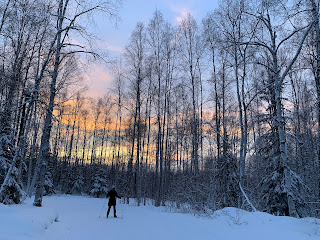
Mostly at my insistence about how much fun we'll have! and how much exercise in the fresh air we'll get!, Hyomin, Geoff, and I rented cross-country skis for the week and went skiing every day before work. Since we worked nights, that meant getting up around 1pm, hustling to ski for a couple hours before the meager daylight faded completely, going out for "lunch" around 6 or 7pm then driving up to the rocket range to work until 3, 4, or 5am. Fairbanks has a community nordic center with lots of different runs including nice hills - man, was the skiing fantastic.  


The place is so big we have to consult the map!

Yeah. Team building. I would also argue that exercising in some way is fundamental to any good scientific research trip, and in the cold, arctic weather this was a pretty good option. (It was literally negative degrees F some days though. Legitimately cold.)

In the early morning hours, when transitioning temporarily to the night shift against your normal internal clock, things can get a bit silly. Some of the Japanese contingent decided to try some extreme-cold-weather experiments one night, like throwing the hot cup of water into the air to watch it turn into a cloud instantaneously. Or (for some reason) leaving a banana outside to freeze and trying to hammer a nail into wood with it. Not sure why that would work. And it didn't. But the banana did hilariously cleave neatly in two during the attempt. Asamura-san decided this was "the lucky banana" for the LAMP mission and asked Sarah to pose with him while clinking the two halves together, an apparently auspicious portent of LAMP's success. 

The lucky LAMP banana

Post-midnight giggles are a thing during overnight campaigns, for sure. We did also manage to capture a fun group shot, complete with banana.


I'll leave you with the legendary Hans Nielsen striking his famous aurora-watching pose: 

I have multiple pictures of Hans in this same pose, spanning different years and geographic locations. 


Friday, December 24, 2021

The LAMP mission: it begins

Restarting the dusty old blog once again to document my current arctic adventures. Does anyone read blogs anymore? 

 A bit of filling in the gaps: My last post to this blog was almost a full decade ago. Since then, I've been focused primarily on data and instrumentation for large satellite missions. But I left a piece of my heart in rockets, and I always wanted to get back to them someday. Academic positions come with a lot of autonomy - yes, must bring in money, must write papers, etc. but in what form, on what topic; that's for me to decide. The current rocket mission, LAMP (Loss through Auroral Microburst Precipitation), is a collaboration between my grad advisor, my grad colleague (slash amazing friend for many years), myself and a few other institutions. The development and launch was delayed a couple years in a row; first, due to an extended government shutdown (anyone remember that one? 2018-2019?), then some kind of global pandemic freakout, I'm not too sure on the details, maybe you've heard of it? And so a 2019 launch became a 2021/2022 launch. Here we are. 

 In the meantime, I've gotten into some other rocket and CubeSat missions. More about that some other time, perhaps. But now - in first quarter 2022 - finally - the LAMP launch is a real thing.

LAMP mission logo by my grad student, Riley Troyer

Super high-level overview: LAMP is designed to study a type of aurora called pulsating aurora, which has been so charmingly described by science writer Thomas Mallon as "thin, luminous gruel" (The Last Rocket Club). In a 180-degree overhead view, it normally looks like large splotches of paint across the sky that pulse with some frequency - patches that turn on and off at the same time or different times than neighboring patches. See the faster-than-realtime video example below. 

Pulsating aurora from MOOSE camera (courtesy of Marilia Samara and Robert Michele, NASA GSFC)

Our understanding of what causes this kind of aurora has evolved over the last few decades. We've seen several breakthrough observational studies since ~2010 that have unambiguously shown a certain type of plasma wave to be responsible for dumping these electrons into the atmosphere. That type of wave exhibits quasi-periodic structures that can be distributed slightly differently in regions of equatorial space, giving this patchy appearance to the aurora as regions of waves dump particles in a regular cadence that is not identical to neighboring regions. Think of a turbulent ocean, with a multitude of waves appearing and disappearing in various patches. What happens out in equatorial space, out in Earth's magnetosphere, connects to what we see in the sky overhead via magnetic field lines that guide particles getting dumped into the atmosphere by these waves. This figure is a decent schematic of the process: 

Jaynes 2018, https://www.nature.com/articles/d41586-018-01669-z


Why do I care? Why does anyone care? Good questions. In this case, I care because I think pulsating aurora, and related precipitation, constitutes a significant or dominant fraction of the energy transfer from the magnetosphere to the atmosphere. Possibly more on this later --- but in general, this energy can cause a chain reaction that affects local levels of ozone and other chemical constituents in Earth's atmosphere. I think we're still fairly lacking in our understanding of this connection, but that's okay - it  makes it an exciting topic to explore. Pulsating aurora contains higher energies (even higher than we used to think) than more frequently studied aurora and it's quite ubiquitous - meaning there's a lot of potential for major energy transfer. My entire NSF CAREER award is based on gaining deeper insights into the cause and morphology of pulsating aurora. 

To prepare for the LAMP mission, Sarah Jones and I and several colleagues and students traveled to Alaska in January 2020 to test ground instrumentation. More about those adventures next time. And then... very soon... preparation and travel to the field for the launch! 


Monday, February 27, 2012

Lots of publicity!


For some strange reason, we have had a lot of media attention over this rocket launch. Maybe not enough tragic death in the world for them right now? Who knows. But they latched on for a few seconds. Here are some of the more interesting links:

Local Fairbanks paper, the News Miner

MSNBC Week in Pictures - Picture #3

CNN video

Foster's Daily Democrat

Astronomy magazine

Pretty good stuff considering NASA didn't publicize this launch at all. (They never do, don't ask me why.)

Allsky image taken by a camera at Poker run by a Japanese group

Sunday, February 19, 2012

We actually launched


For real! The aurora was beautiful, the night was clear. We even saw aurora earlier that night at twilight, it was so bright. The science was pretty close to ideal, so they called the launch and here it is:


I'm worn out at the moment but sometime very soon I will post pictures on here that I took that night. I caught the launch (sort of) and the first stage motor burn falling out of the sky. And I have a bazillion pictures of aurora since it was my first time trying to photograph it. Some turned out quite nicely. Goodnight!

Friday, February 17, 2012

We *almost* launched!


Wow, Tuesday night was a crazy time, a whirlwind of chaos and activity that resulted in bringing the count down to T -00:34 (34 seconds to launch) before Science aborted the call. There was aurora all night long after that initial close call, although the PI (Steve Powell) ended up calling it "too much aurora". Sigh.

So the night began as I went down to the kitchen to call home and leisurely chat with Matthew on Skype. This is a common practice, since the beginning of the launch window is normally a pretty slow time. But Tuesday it was not. Someone came running in the room to tell me that Steve just picked up the count (which means he called in to start the clock at T -10 minutes), and so I had to slam my laptop closed and do the ridiculous rush to get my stuff together and bolt out the door to the car. I'm supposed to be down the hill at the TM (telemetry) trailer at about 5 minutes to launch to give a GO that our instruments are functioning properly before we launch (or a NO GO if they're not). So I careened down the icy hill in the SUV - - no sweet handbrake slides, alas. Ran into TM just in time to check the charts and give a GO on the ERPA instruments. Then at T -:60 I gave my final okay and ran outside with about half a dozen others to watch the rocket launch. We could see the launch pad all lit up and the rocket pointing upwards, waiting. We counted down in our heads... and nothing. Steve had aborted the launch, due to changing science conditions. But, man, was that adrenaline pumping!

So we recycled the count back up to T -10. The rest of the night saw a lot of other iffy situations where we almost dropped the count once again. I ended up camping out in TM all night long since we were usually on the verge of counting down. Aurora came and went; arcs appeared but then didn't move into the position we wanted, or ended up breaking up too soon. Three substorms (or maybe mini-substorms?) raged overhead at different points in the night. It made for a very pretty show for us here at Poker and the downrange sites, but for science conditions it just wasn't what we wanted. We needed a quiet, stable, stationary arc and just never got one. Steve "Too Much Aurora" Powell had a fun (read: frenzied and suspenseful) night though. After all that adrenaline, I dropped into the best sleep I've had since I arrived here.

Check out the light show we had!

Photo by Craig Heinselman


Monday, February 13, 2012

The View is Nice


Tonight was just observing for fun and for the science team to practice. And we've had a great night for aurora. Here is a shot taken by Craig Heinselman (our resident radar expert) just a little while ago. Standing in the foreground you see: Phil Fernandes & Dave Collins (Dartmouth) and Rob Micelli (Cornell).

See more of Craig's MICA photos here.

Travel like a pro

 Link to my expert travel tips piece published over at Medium:  https://medium.com/@allisonjaynes/how-to-travel-like-a-pro-789558450056